
Why Apple’s Foldable iPhone May Be Smaller Than Expected
How Apple’s rumored foldable iPhone could redefine the user experience with a compact outer display and bold design trade-offs

The dream of the “iPhone Fold” has always been expansive—taking the familiar iOS experience and stretching it across a transformative new canvas. For years, industry observers expected Apple to follow Samsung and Google: refine the competition’s approach, then launch an ultra-premium foldable that aligns with current market trends.
A new report from The Information, however, points to a very different strategy.
Rather than a large device that folds in half, insiders indicate Apple is pursuing a more compact concept with an outer display measuring just 5.3 inches—smaller even than the discontinued iPhone mini. For a phone rumored to cost above $2,000, this scaled-back front screen may seem counterintuitive. Yet, when viewed through Apple’s lens of purposeful design, this reduction could unlock the foldable category’s true value.
Here’s a closer look at why Apple might be going small to win big.
The 5.3-Inch Surprise
Recent leaks suggest Apple’s book-style foldable includes an outer display that stands apart from current foldable designs. While Samsung’s Galaxy Z Fold 7 features a generous 6.5-inch front screen and Google’s Pixel Pro Fold sports a 6.3-inch cover display, Apple’s rumored 5.3-inch panel is a notable departure.
This isn’t a matter of shaving off a few millimeters; it represents a fundamental rethinking of the folded device’s role.
The iPhone mini (at 5.4 inches) faced criticism for its cramped screen, especially for media consumption. By opting for an even smaller exterior, Apple signals that the folded state is not intended to be used as a full phone. Instead, the closed device is designed for quick triage—checking notifications, replying to messages, managing music—while the full iPhone experience emerges when the device is unfolded.
The Geometry of Multitasking
Why would Apple choose a smaller outer screen? The answer lies in the geometry of foldable displays.
Book-style foldables require distinct trade-offs:
Option A (Samsung’s Approach): Focus on a tall, narrow outer display. The result? The inner panel opens to a nearly square tablet.
Option B (The Pixel/Apple Approach): Prioritize a rectangular, landscape-oriented inner display. The trade-off is a shorter, wider outer screen.
The “Square” Problem
Square displays struggle with mainstream content. Most videos are 16:9, and most apps are designed for vertical scrolling. On a square screen, this means letterboxing for video and awkward layouts for split-screen multitasking.
Apple appears to prioritize the inner display, targeting an internal 4:3 aspect ratio similar to the iPad. This orientation ensures that multitasking, video playback, and tablet-class apps feel right at home. Achieving this layout requires the outer screen to be more compact. The 5.3-inch size is less a limitation and more an inevitable byproduct of this internal design goal.

Rethinking the “Phone” Experience
Apple’s rumored approach is a response to the identity crisis of many current foldables.
Products like the Pixel Pro Fold try to be both a full-sized smartphone and a tablet, often ending up bulky and awkward in-pocket. By going smaller on the outside, Apple appears to be prioritizing portability and more focused use cases.
The “Glanceable” Era
A smaller outer screen reshapes user behavior. It discourages endless scrolling on the cover display and instead turns the closed device into a dashboard for essential interactions.
Quick Actions: Glance at messages, control music, check widgets.
Intentionality: Unfold the device for immersive tasks—browsing, typing, watching video.
This creates a psychological distinction between quick tasks and deeper engagement, echoing Apple’s approach with Focus Modes and the glance-based Apple Watch UI. The act of unfolding becomes a purposeful shift, not just another tap.
Comparing the Competition
To understand the significance, consider the current foldable landscape:
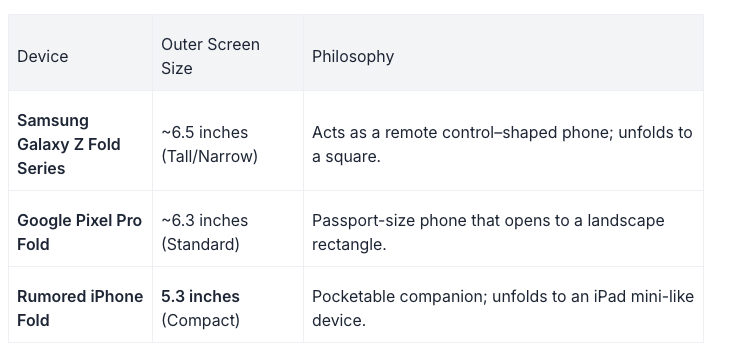
Apple’s bet is clear: many users don’t want a thick, heavy phone in their pocket. They want the flexibility of a tablet in a device that disappears when not in use. By shrinking the outer footprint, Apple may address the biggest pain point of today’s foldables—bulk.
The Pricing Paradox
Rumors suggest the foldable iPhone could debut between $2,000 and $2,500.
Consumers often equate “bigger” with “better value”—a challenge for a device with Apple’s smallest screen but highest price tag. Yet, Apple has a history of redefining premium by prioritizing portability and technology over raw size. The original MacBook Air was expensive for its class but succeeded because of its unmatched portability.
For the iPhone Fold, Apple will likely highlight the advanced inner display and innovative engineering as justifications for the cost. The focus will be on how much technology and versatility are packed into a singular, streamlined package.
What This Means for the Ecosystem
If Apple commits to this compact approach, it could bring sweeping changes to iOS:
Split View Evolution: The inner display could usher in a new era of iPadOS-inspired multitasking, blurring boundaries between phone and tablet.
App Redesigns: Developers will need to create flexible interfaces—usable at 5.3 inches, and instantly expanding for multi-window use on the inner screen.
Future of iPad Mini: As a foldable iPhone mirrors the function of an 8-inch tablet, Apple’s smallest iPad may see a new challenger within its own ranks.
Final Thoughts
At first glance, a 5.3-inch outer display might seem like a step backward. In the age of giant, 6.9-inch Pro Max phones, it sounds limiting. But the true value of a device is measured not in size alone, but in experience and utility.
If Apple’s real goal is to deliver the best portable tablet experience—not merely to create a folding phone—the trade-off becomes clear. Sacrificing a larger exterior screen allows Apple to perfect everything that happens inside, reimagining what a foldable device can be. It’s a bold bet: focus on function and seamless transition, even if it means challenging our expectations of what premium means.
If you enjoy Apple Secrets, please consider becoming a paid subscriber to support our work.
We publish daily Apple news, insights, and stories that matter to our readers.
Like most newsletters, fewer than 5% of our subscribers are paid.
Your support at $5/month or $45/year helps us keep Apple Secrets independent and growing into 2026.
Thank you for being here ❤️